Inside Melk Abbey: The Rooms, the Library and the Church
Hours, prices and access verified by the Melk Abbey Tours team — last checked 2026-09-16.
The visit climbs the Imperial Staircase, runs the length of a 196-metre corridor,
crosses the Marble Hall and the balcony into the library, and ends in the church. Choosing a
Melk Abbey guided tour? This is what each part holds, in the order you walk it.
The Imperial Staircase and the 196-metre corridor
Imperial Corridor: 196 metres (643 feet) along the
first floor of the southern wing, hung with portraits of Babenberg and Habsburg rulers.
The Imperial Staircase rises from the south-west corner of the Prelate's Courtyard. It has
limestone columns and rich stucco decoration. Two figures stand for Perseverance and Courage, the motto of
Emperor Charles VI, and a double-headed eagle fills the ceiling. The rooms at the top were kept for
noble guests.
The corridor runs almost the whole southern wing. Most of its portraits were painted in the
eighteenth century by Franz Joseph Kremer, a pupil of Paul Troger.
The museum in the Imperial rooms
The former imperial guest rooms hold the museum, "The Path from Yesterday to Today". Each room
takes one theme.
- Saint Benedict and the founding of the Benedictine order
- The Babenbergs, Saint Coloman and the founding of the abbey
- The abbey and the Church in the Middle Ages
- Romanesque and Gothic style
- The Baroque attitude to life
- Abbot Berthold Dietmayr and the Baroque abbey
- Enlightened absolutism and Josephinism
- The people who live and work in the abbey
- The Melk altar of 1502, also called the Breu altar
- The abbey's economy and building history
- A model of the whole building
The Marble Hall and Troger's ceiling
The Marble Hall was the dining and festival hall for the imperial family and other important
guests. Paul Troger painted its ceiling fresco in 1731. At the centre Pallas Athena rides a
chariot drawn by lions, for wisdom and moderation. Hercules stands beside her, overcoming the
three-headed hound of hell.
Both figures point to Emperor Charles VI, who liked to be cast as Hercules. The painted
architecture around them is by Gaetano Fanti. The door frames are real marble from Adnet and
the Untersberg, near Salzburg, but the walls are marble stucco. Over the doors, lines from the
Rule of Saint Benedict ask that guests be received as Christ.
The balcony and the west view
A terrace links the Marble Hall to the library. From it you look west over the town of Melk
and the Danube, and back at the church towers. It is outdoors, so you can take photos here,
which you cannot do in the rooms either side.
The library, and the 2026–2027 restoration
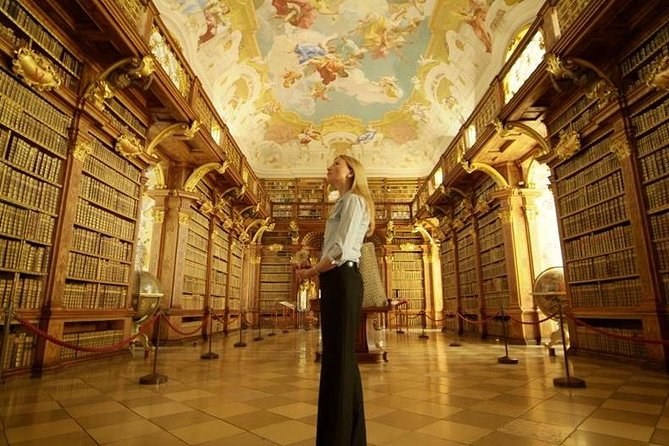
The library: more than 100,000 books, including about
1,800 manuscripts and 750 incunabula. About 16,000 are on view in two rooms furnished in
1735.
You see the main room and the room beside it, on the first floor. Together they were the
whole library when it was furnished. The Upper Library, two rooms painted by Johann Wenzel Bergl
and added in 1768, is not on the visit. The library is still a working one, used by researchers
from around the world.
A restoration running from 2022 to 2032, costed at €12 million, has reached these two rooms.
The library stays open, and the Baroque volumes stay on the shelves.
- From October 2025: part of the collection moves out of both rooms to
another store, while the Baroque volumes stay on display.
- January to early April 2026: scaffolding in the main hall for the
frescoes.
- 2026: partition walls on the north side of the small room and the south
side of the main room.
- 2027: the walls swap sides. Work continues to the end of the year.
The abbey church and its artists
The church was meant only to be modernised. After 1701, at Abbot Berthold Dietmayr's wish, it
was rebuilt completely to Jakob Prandtauer's plans. Its gold leaf, stucco and marble run through
gold, ochre, orange, grey and green.
Antonio Beduzzi: the interior design and the sketches for the frescoes.
Johann Michael Rottmayr: the frescoes and altar paintings.
Paul Troger: altar paintings.
Giuseppe Galli-Bibiena: the designs for the pulpit and the high altar.
Mattielli and Widerin: Lorenzo Mattielli designed the sculptures, and Peter
Widerin carved them.
Saint Coloman's relics lie in a sarcophagus in the left transept altar. The altar opposite is
Saint Benedict's, and its sarcophagus is empty. The high altar's inscription reads "Non
coronabitur nisi legitime certaverit": without a legitimate battle there is no victory.
The Northern Bastion and the Wachau Lab
Two bastions frame the abbey gate. The southern one faces the town, and the Northern Bastion
faces the park. Prandtauer planned it, and it was built in the first half of the eighteenth
century.
Its panoramic terrace, on the second floor, looks out over the park and the garden pavilion,
from the Alpine foothills to Lower Austria's Forest Quarter. An outdoor staircase leads straight down into the park. The first floor holds
the Wachau Lab, where students of the abbey school stage changing exhibitions. The gift shop is
on the ground floor.
The mineral collection in the prelate's library
The minerals fill the former prelate's library, a Baroque room with stucco and a ceiling
painted in 1643. That painting shows the abbey before its Baroque rebuild. The collection opens
from April to October, daily from 13:30 to 15:30, for 25 people at a time. It is not step-free.
The park and Bergl's garden pavilion
The park: open April to October, 9:00 to 18:00 from 1
April to 24 October and 9:00 to 17:00 at either end of the season. Your abbey ticket covers
it.
The Baroque park replaced the abbey's vineyard and orchard in the eighteenth century. It
opened to visitors in 2000 after a fifteen-year revitalisation, laid out on three levels. The water basin
sits among linden trees about 250 years old.
Franz Munggenast built the garden pavilion in 1747 and 1748 for the monks to rest in after
fasting. Johann Wenzel Bergl painted it in 1763 and 1764 with exotic animals, jungle plants and
the four continents then known. From April to October a self-service café runs in the pavilion.
What the guided tour covers and what you see alone
The guided tour takes about 50 minutes and ends at the library. Everything after that is at
your own pace, so allow at least two and a half hours for the whole visit.
| Space | On the guided tour | On your own | Season |
|---|
| Imperial Staircase and Corridor | Yes | Yes | All year |
| Museum in the Imperial rooms | Yes | Yes | All year |
| Marble Hall | Yes | Yes | All year |
| Balcony | Yes | Yes | All year |
| Library, two historical rooms | Yes | Yes | All year; partition walls to end-2027 |
| Abbey church | No, you continue alone | Yes | All year |
| Northern Bastion and Wachau Lab | No | Yes | All year |
| Mineral collection | No | Yes, 13:30–15:30 | April to October |
| Abbey park and garden pavilion | No | Yes | April to October |
| Upper Library, the Bergl rooms | No | No | Not open to visitors |
Want a guide for the rooms?
Some day tours from Vienna put the abbey's guided tour in the fare. Compare which do, and how long each gives you inside.
Photos inside and outside the abbey
You cannot take photos or film in the interior rooms: the museum, the Marble Hall, the library
and the church. Outdoors you can, on the balcony, in the courtyards, the park, the pavilion and
the bastion. The library frame in the Melk Abbey gallery shows what the
main room looks like.
The rooms the visit does not show
The Upper Library, with its two Bergl rooms, is closed to visitors. The abbey has 497 rooms and
1,365 windows, and the visit shows you only a part of them.
Tours that can take you through the rooms with a guide
Your own guide from your hotel at 8:30, with Dürnstein, the river cruise from Spitz to Melk and a private 75-minute tour of the abbey, all in the fare.
From $741 per person
Check Availability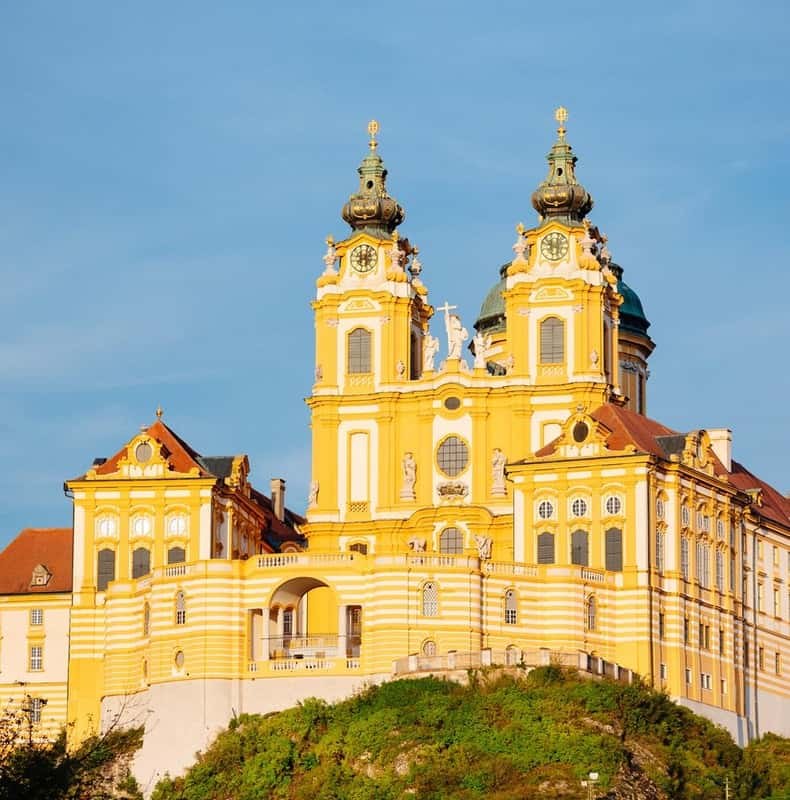
Krems, Dürnstein, an hour free in Melk and a 75-minute guided abbey visit, which is in the fare on winter dates and on the all-inclusive option in summer, when a Danube boat joins the day.
From $136 per person
Check Availability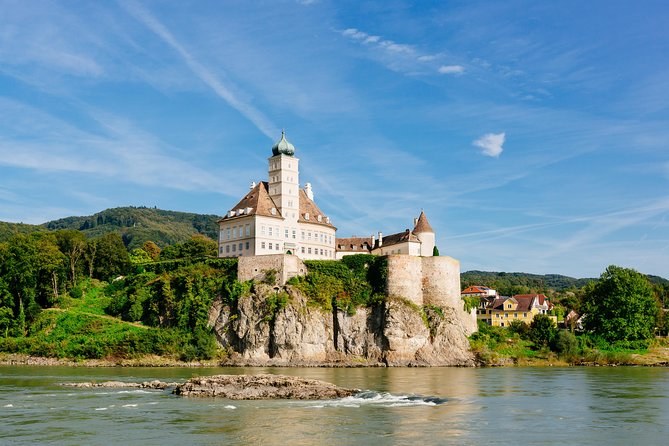
A 9:00 coach from the State Opera to Dürnstein, a short Danube cruise from April to October and 90 minutes at the abbey, with admission and a guided tour on the option that includes them.
From $142 per person
Check Availability